
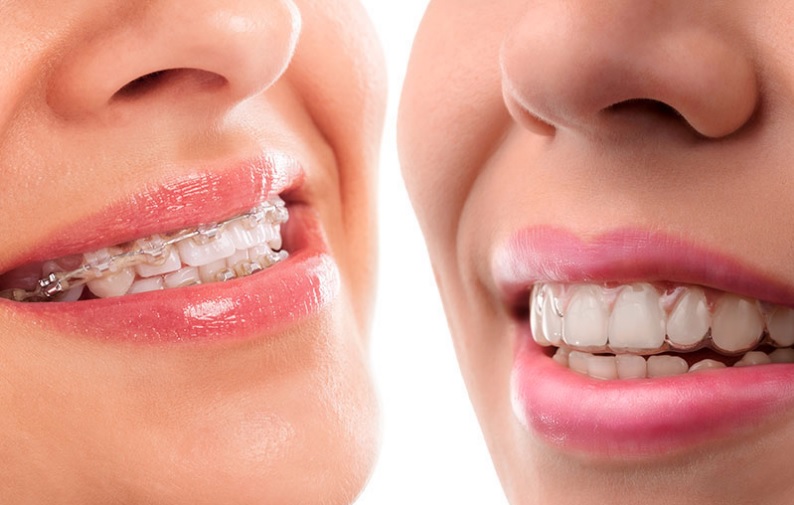
Cost is a fair question, but the cheaper option is not necessarily the appropriate one. Which appliance suits you depends on your clinical presentation, and that requires an examination. This article sets out how the two compare on cost and on practical differences.
How the two compare
Fixed braces are bonded to the teeth and cannot be removed by the patient. That means treatment does not depend on the patient remembering to wear an appliance, and there is nothing to misplace.
Clear aligners are removable, so there are fewer restrictions on food and drink and cleaning teeth is more straightforward. Teeth should be cleaned before the aligners are put back in. Aligners only apply force while being worn, generally 20 to 22 hours a day, so treatment depends on the patient. Aligners can be lost or damaged and replacements are charged.
Aligners are less noticeable than metal brackets, though they are not invisible and the attachments bonded to the teeth can be seen at close range. Fixed braces can cause ulceration and irritation of the lips and cheeks, particularly early in treatment; aligners can irritate the tongue and gum margins and may temporarily affect speech.
Neither appliance is consistently faster. Treatment duration depends on the complexity of the case and, for aligners, on how consistently they are worn. Both require retainers afterwards, generally long term.
Neither appliance produces better results across the board. Some tooth movements and more complex bite corrections are more predictably achieved with fixed appliances, and clear aligners are not suitable for every case.
Cost in Sydney
Published price guides put clear aligner treatment at roughly $7,000 to $9,000 and fixed braces at roughly $8,000 to $15,000. These are indicative figures drawn from published sources rather than quotes, and the ranges overlap.
Neither appliance is consistently cheaper. A straightforward case treated with aligners may cost less than fixed braces, while a complex case treated over a longer period may cost more. The useful comparison is between the two treatment plans proposed for your case, not between the appliance types in general.
Fees at North Sydney Dentistry
Clear aligner treatment in North Sydney is available with a payment plan from $25 per week. This is a repayment amount, not the total cost of treatment.
Fixed braces are provided at our Hornsby and Macquarie Park practices. Fees start from $4,500 and range to $6,000 or more depending on the complexity of the case.
Additional costs to factor in
Aftercare costs are part of the total. Retainers are needed at the end of treatment and need replacing periodically. Lost or damaged aligners and broken brackets are charged. Ask what a quoted fee covers and what falls outside it.
Health fund benefits
Some private health insurance extras policies include an orthodontic benefit, generally subject to waiting periods, annual limits and a lifetime limit that may cover only part of the fee. Cover varies between funds and policies, so check with your fund directly.
Risks
Both treatments carry risks. These can include discomfort and tooth sensitivity, ulceration and irritation of the lips, cheeks and gums, decalcification and decay where oral hygiene is not maintained, shortening of tooth roots, gum recession, temporary changes to speech with aligners, and relapse if retainers are not worn as directed. Some cases require extractions or additional procedures, and treatment may take longer than estimated.
Results vary between individuals and no outcome can be guaranteed.
To discuss which option is appropriate for your case, contact North Sydney Dentistry to arrange an assessment. You will receive an explanation of the options and their risks and a written quote before treatment begins.