
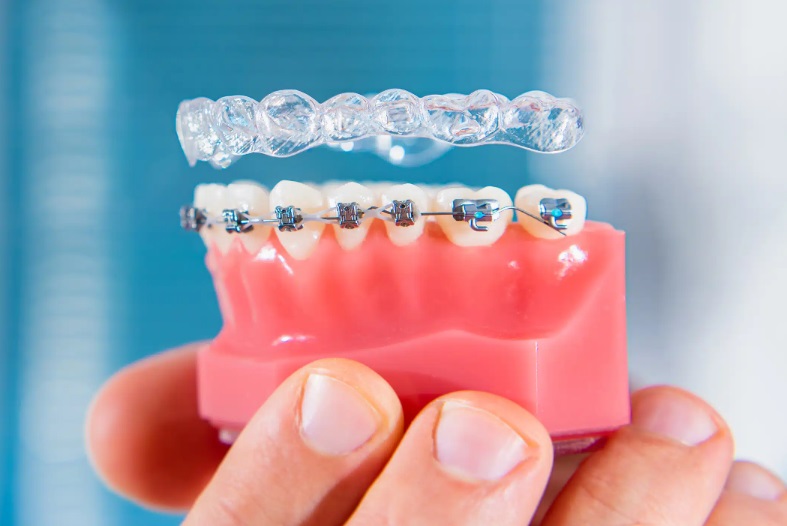
Deciding between Invisalign vs braces is a common question for people considering orthodontic treatment. The two appliances work differently and suit different cases, so the comparison below is general information rather than a recommendation.
Which appliance is appropriate for you is a clinical decision made after examination, not a matter of preference alone.
At North Sydney Dentistry we provide clear aligner treatment, and fixed braces are available at our associated practices. We are at Level 1, Suite 102/71 Walker St, North Sydney NSW 2060.
The Two Options
What are Clear Aligners?
Invisalign uses a series of clear, removable aligners custom-made to fit your teeth and worn in sequence to move them gradually into a planned position.
What are braces?
Fixed braces use brackets bonded to the teeth and wires that are adjusted periodically to move teeth into the planned position.
How they differ
Both are used to address a range of orthodontic problems, but the method differs. Aligners rely on a sequence of appliances; braces use the wire to apply force. They are not interchangeable, and not every case can be treated with either.
Appearance and comfort
- Visibility
Clear aligners are less noticeable than metal brackets and wires. They are not invisible, and attachments bonded to the teeth during treatment can be seen at close range. Braces are more visible, though ceramic brackets are less noticeable than metal ones.
- Comfort
Both appliances cause pressure and tenderness, particularly after an aligner change or a wire adjustment. Brackets and wires can rub the inside of the lips and cheeks and cause ulceration, especially in the early weeks. Aligners can irritate the tongue and gum margins and may temporarily affect speech.
- Day-to-day
Aligners are removed to eat and drink. With braces, hard, sticky and chewy foods need to be avoided to prevent breakages.
Cleaning and Maintenance
- Daily routine
Aligners need regular cleaning to avoid staining and bacterial build-up. Braces require careful brushing and flossing around the brackets. With either appliance, poor oral hygiene during treatment increases the risk of decalcification, decay and gum problems.
- Access
Cleaning is generally more straightforward with aligners because they are removed. With braces, interdental brushes or a water flosser may be needed to reach around the brackets.
- Professional cleaning
Regular dental check-ups and professional cleaning are important with both.
Treatment Time
- Duration
Duration depends on the individual case. Clear aligner treatment commonly runs from about 6 to 18 months and fixed braces from about 12 to 24 months, but these are general ranges and treatment may take longer than estimated.
- Appointments
Aligner patients are typically reviewed every 6 to 8 weeks. Braces generally require adjustments every 4 to 6 weeks.
- Speed
Neither appliance is consistently faster. Time to completion depends on the complexity of the case and, for aligners, on how consistently they are worn.
Cost considerations
- Comparing fees
Aligner and braces fees overlap and vary with treatment length and complexity. Neither is consistently cheaper. The useful comparison is between the two treatment plans proposed for your case.
- Health fund benefits
Some private health insurance extras policies include an orthodontic benefit, generally subject to waiting periods, annual limits and a lifetime limit that may cover only part of the fee. Cover varies between funds and policies, so check with your fund directly.
- Additional costs
Ask what a quoted fee includes: records and scans, appliances, adjustment or review appointments, refinement aligners, retainers, and replacement of lost or damaged appliances. Where these are charged separately, that should be stated in your written quote.
Suitability for different cases
- Milder cases
Clear aligners are commonly used for mild to moderate crowding, spacing and minor misalignment.
- More complex cases
Fixed braces are often recommended for more significant bite corrections or where complex tooth movements are required, as they give the practitioner greater control over individual tooth positions.
- Ongoing adjustment
Both require ongoing adjustment. Aligners are changed every one to two weeks; braces are adjusted at review appointments.
Lifestyle Factors
- Eating and drinking
With clear aligners, the aligners are removed to eat and drink, and teeth should be cleaned before they are put back in. Braces require avoiding foods that can damage brackets or wires.
- Compliance
Aligners only work while they are being worn, generally 20 to 22 hours a day. Braces do not depend on the patient in the same way, which is a relevant consideration for some people.
- Sport
Aligners can be removed during sport. A mouthguard is recommended for contact sport with either appliance, and a custom mouthguard designed for use over braces is needed for patients wearing fixed appliances.
Age considerations
Both appliances are used for adolescents and adults. Suitability depends on the individual case, including whether jaw growth is complete, rather than on age preference alone.
Making the decision
- Assessment
At North Sydney Dentistry we examine your teeth, gums and bite and explain which options are appropriate for your case and why, together with the risks involved and a written quote.
- Provider status
North Sydney Dentistry holds Invisalign Platinum Elite Provider status. This is a tier assigned by Align Technology, the manufacturer, based on the number of cases a practice treats. It is a commercial classification rather than an award or an assessment of clinical quality by a regulator or professional body.
Risks
Both treatments carry risks. These can include discomfort and tooth sensitivity, ulceration and irritation of the lips, cheeks and gums, decalcification and decay where oral hygiene is not maintained, shortening of tooth roots, gum recession, temporary changes to speech with aligners, and relapse if retainers are not worn as directed after treatment. Some cases require extractions or additional procedures, and treatment may take longer than estimated.
Retainers are needed after either treatment, generally long term.
Results vary between individuals and no outcome can be guaranteed.
Arranging a consultation
To discuss which option is appropriate for your case, contact us on (02) 8090 1108 or visit us at Level 1, Suite 102/71 Walker St, North Sydney NSW 2060 to arrange an assessment for orthodontic treatment in North Sydney.