
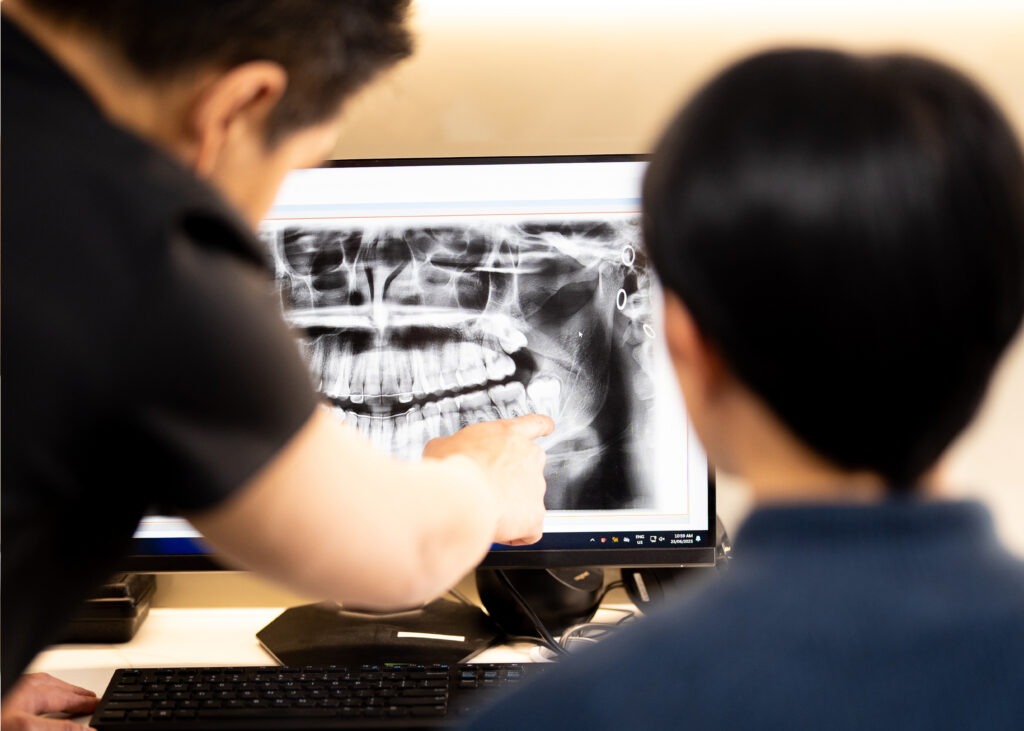
Dental X-rays let your dentist see what a visual examination can’t: decay between teeth, problems under old fillings, infection at the root tips and the health of the bone that holds your teeth in place. The radiation dose is low, and your dentist should only take them when the information will help with a decision about your care.
X-rays are one part of what a dental check-up involves. This guide explains the main types, what each one shows, how safe they are, what to do if you’re pregnant, and how often you’re likely to need them.
Why your dentist takes dental X-rays
Many problems start where no one can see with a mirror. The tight contact points between back teeth are a common spot for decay, and it can grow quite large inside a tooth before there’s a visible hole or any pain.
X-rays can help your dentist:
- find decay between teeth and underneath existing fillings or crowns
- check bone levels, which shows whether gum disease is causing bone loss
- look for infection or an abscess at the tip of a root
- see teeth that haven’t come through yet, including wisdom teeth
- plan treatment such as root canal therapy, extractions or dental implants
Catching these issues early is the heart of preventive dentistry.
The main types of dental X-rays
Bitewing X-rays
For a bitewing, you bite gently on a small tab or holder while a sensor sits inside your mouth. Each image shows the crowns of the upper and lower back teeth together, along with the bone between them. Bitewings are the X-ray most often taken at a routine check-up because they are good at showing decay between teeth and early bone loss.
Periapical X-rays
A periapical X-ray shows one or two teeth from the biting surface all the way to the tip of the root and the bone around it. Your dentist may take one if you have a toothache, a cracked tooth, swelling or a tooth that has been knocked. They are also used during root canal treatment and before an extraction.
Panoramic X-rays (OPG)
An OPG (orthopantomogram) is taken outside your mouth. You stand still, bite on a guide, and the machine rotates around your head for a few seconds. The result is one wide image of all your teeth, both jaws and the jaw joints. It is useful for checking wisdom teeth, overall bone levels and other changes in the jaw. It shows less fine detail than a bitewing, so the two are often used together.
Are dental X-rays safe?
Dental X-rays use a very small dose of radiation. The dose from a bitewing is often compared with the natural background radiation we all receive from the environment over a day or so. A panoramic X-ray involves a somewhat higher dose, but it is still low.
Even so, any radiation exposure should be kept as low as reasonably achievable. That is why good practice includes:
- taking X-rays only when they are clinically justified, not on a fixed routine for everyone
- choosing the type and number of images that answer the question with the least exposure
- using digital sensors, which generally need less radiation than older film
- using previous X-rays where they are recent enough, rather than repeating them
If you’re worried about radiation, ask your dentist why a particular X-ray is recommended and what it may show.
X-rays during pregnancy
If you are pregnant or think you might be, tell your dentist before any X-rays are taken. Routine X-rays are usually deferred until after the baby is born. If you have pain, swelling or a suspected infection and an X-ray is needed to treat you safely, your dentist will discuss the options with you, as leaving a dental infection untreated also carries risks.
How often do you need dental X-rays?
There is no single schedule that suits everyone. How often you need them depends on your risk of decay and gum disease, your age, and what your dentist finds during the examination.
- Higher risk: if you’ve had several new cavities recently, have a dry mouth, snack often on sugary foods or have active gum disease, bitewings may be recommended more often.
- Lower risk: if your teeth and gums have been stable for years, the gap between bitewings can be longer, sometimes a couple of years or more.
- Children and teens: timing depends on how their teeth are developing and their risk of decay.
- Problems between visits: a toothache, swelling or injury may need a periapical X-ray at any time.
A panoramic X-ray is usually taken at a first visit when needed, and then only occasionally, for example to check wisdom teeth or plan treatment.
What to expect when X-rays are taken
- You may be asked to remove earrings, glasses, hairpins or removable dentures, as metal can show up on the image.
- For bitewings and periapicals, a small sensor is placed in your mouth. If you have a strong gag reflex, tell us and we can take things slowly.
- You keep still for a moment while the image is taken. It is usually over in seconds.
- The digital images appear on screen, and your dentist can show you what they see.
Bring your previous X-rays
If you’re changing dentists, ask your previous practice to send your recent X-rays, or bring digital copies with you. This can help your new dentist avoid repeating images you don’t need and compare old and new images.
For new patients at our North Sydney practice, bitewing X-rays and a panoramic X-ray are included in the check-up and clean offer as needed. It is no gap for eligible health fund members, depending on your level of cover, or $219 if you don’t have private health insurance. See our new patient specials for details. A scale and clean is also part of that visit, and you can read more about teeth cleaning in North Sydney.
If you have severe pain, swelling or a broken tooth, don’t wait for a routine visit. See our emergency dentist page. Call 000 or go to hospital if you have difficulty breathing or swallowing, or facial swelling that is spreading quickly.
Frequently asked questions
Do I need X-rays at every check-up?
No. Your dentist will decide based on your risk of decay and gum disease, what they see during the examination and when your last X-rays were taken.
Can I have dental X-rays while pregnant?
Tell your dentist if you are or might be pregnant. Routine X-rays are usually put off until after the birth. If you have pain or infection and an X-ray is needed, your dentist will talk through the options with you.
What is the difference between a bitewing and an OPG?
A bitewing is a small image taken inside the mouth that shows the back teeth in detail, which helps find decay between teeth. An OPG is taken outside the mouth and shows all your teeth and jaws in one wide image.
Can my new dentist use X-rays from my old dentist?
Often, yes. Ask your previous practice to send recent digital X-rays before your visit.
Book your check-up
North Sydney Dentistry is at Level 1, Suite 102/71 Walker St, North Sydney, a two-minute walk from North Sydney station. We’re open Monday to Friday, 9am to 6pm. Call (02) 8090 1108 or book online.
This article is general information only and is not a substitute for advice from your own dentist or doctor. Any surgical or invasive procedure carries risks. Before proceeding, you should seek a second opinion from an appropriately qualified health practitioner.