
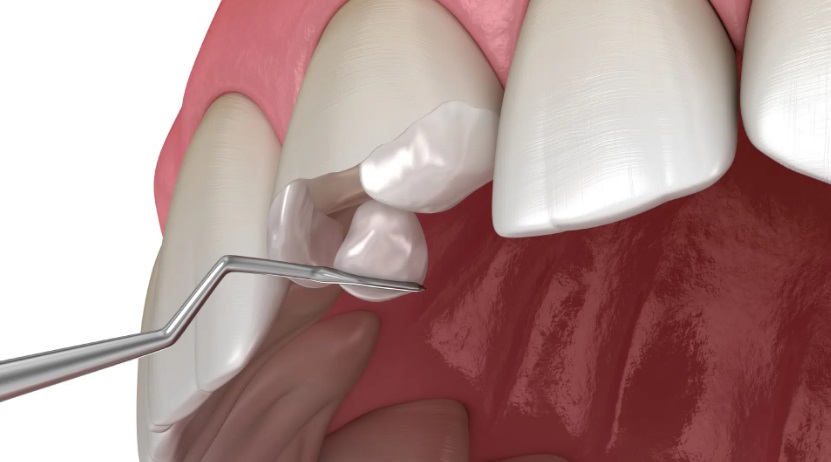
Composite resin veneers are thin coverings of tooth-coloured composite resin bonded to the front of the teeth. They are used to change the appearance of teeth affected by discolouration, chips, small gaps and minor irregularities in position.
Veneers are a cosmetic treatment. They do not treat decay, gum disease or bite problems, and those conditions need to be addressed before veneers are considered.
What are composite resin veneers?
Composite resin veneers, often called composite veneers, are built up directly on the tooth from a resin material and shaped by the dentist at the chairside. Unlike porcelain veneers, which are made in a laboratory, composite is placed and sculpted in the mouth, which is why treatment can often be completed in a single visit.
IMPORTANT — composite veneers generally require less enamel removal than porcelain, and in some limited cases none at all. Where enamel is removed, that step is permanent and the tooth will require restoration from then on. Ask your dentist specifically how much enamel your case would involve, as this varies considerably and directly affects how reversible the treatment is.
How composite compares with porcelain
- Cost: Composite veneers generally cost less than porcelain.
- Time: Treatment can often be completed in one appointment rather than over several visits.
- Enamel: Less enamel removal is usually required, and in some cases none.
- Repairability: Composite can generally be repaired or added to. Damaged porcelain usually has to be replaced.
- Lifespan and staining: This is where composite is at a disadvantage. Composite stains, chips and wears more readily than porcelain. Published estimates commonly put its lifespan at around 5 to 7 years, compared with roughly 10 to 15 for porcelain, though both vary considerably with the individual, the bite and oral hygiene. Composite may need polishing, repair or replacement more often, which is an ongoing cost.
Who composite veneers may suit
Composite veneers may be considered where the cosmetic concerns are minor, such as small chips, discolouration or gaps. Healthy teeth and gums are a prerequisite: active decay or gum disease must be treated first.
They are less likely to be appropriate where there is significant grinding or clenching, where the bite would place heavy force on the front teeth, or where the extent of change wanted is beyond what composite can achieve predictably. Where teeth are significantly crowded or rotated, orthodontic treatment addresses the underlying position and may be a better option than covering the teeth.
The Process
- Initial consultation. Your dentist examines your teeth, gums and bite, takes any necessary X-rays, discusses what you want to change and explains the options, including alternatives such as whitening and orthodontics. You should receive an explanation of the risks and a written quote before proceeding.
- Preparation and placement. The tooth surface is lightly etched to allow bonding. Where required, a small amount of enamel is removed. The composite is applied in layers, shaped, hardened with a curing light and polished.
- You are given instructions for looking after the veneers, and a review appointment may be arranged.
Looking after composite veneers
- Oral hygiene: Brush and floss regularly. The margin where a veneer meets the tooth is a site where decay can start, so cleaning around veneers matters.
- Avoid hard foods: Do not bite into hard objects that could chip the composite.
- Regular check-ups: Attend regular examinations and professional cleaning so the veneers and the underlying teeth can be monitored.
- Limit staining: Composite stains more readily than porcelain. Limiting coffee, tea, red wine and tobacco helps maintain the appearance.
- Grinding: Tell your dentist if you grind or clench your teeth. A nightguard may be recommended.
- Shade matching: Composite shades are matched to your natural teeth at placement. If you are considering whitening, do that first, because the composite will not lighten with whitening treatment and would then no longer match.
Risks and limitations
Composite veneers are elective cosmetic treatment and carry risks that should be explained to you before you agree to proceed:
- where enamel is removed, that removal is permanent and the tooth will require restoration from then on
- tooth sensitivity, usually temporary but sometimes persistent
- staining, chipping and wear over time, requiring polishing, repair or replacement at ongoing cost
- gum irritation, and recession over time exposing the margin
- debonding of the veneer
- a shorter lifespan than porcelain
Results vary between individuals and depend on the starting condition of the teeth, the bite and the treatment plan. No outcome can be guaranteed.
Composite veneers at North Sydney Dentistry
Our dentists provide composite veneers as part of general dental practice. All are registered with the Dental Board of Australia and their registration can be verified on the Ahpra public register.
Fees and payment
Composite veneer fees depend on the number of teeth treated and the extent of the work. We offer an interest-free payment plan from $30 per week. This is a repayment amount, not the total cost of treatment.
Consultation
At your consultation we examine your teeth and gums, discuss what you want to change and the options for achieving it, explain the risks and provide a written quote. Where composite veneers are not appropriate for your case, we will tell you.
To find out whether composite veneers are suitable for you, contact us to arrange a consultation.